
Troubleshooting Dead Outlets
Learn the most common causes of dead outlets and how to troubleshoot them, from tripped breakers and GFCI outlets to loose wires and nearby outlets on the same circuit.
ELECTRICAL
4/9/20265 min read
Disclosure: This post may contain affiliate links. As an Amazon Associate we earn from qualifying purchases.
Few things are more annoying than plugging something in and realizing the outlet is completely dead. Sometimes it is just one receptacle. Other times it is half a room, a bathroom outlet, garage outlet, or even an outdoor plug that suddenly stops working.
The good news is that a dead outlet does not always mean a major electrical problem. In a lot of cases, the issue comes down to a tripped breaker, a tripped GFCI, a loose connection, or another outlet on the same circuit causing the problem.
Here is a beginner-friendly guide to help you understand the most common causes of dead outlets and what to check first.
Start With Safety First
Before doing any electrical troubleshooting, safety matters.
A few basic rules:
• never work on energized wiring
• do not remove an outlet from the wall unless power is shut off
• if you see burnt wiring, melting, smoke damage, or signs of overheating, stop and call a licensed electrician
• if you are not comfortable working around electrical circuits, do not guess
Simple checks are fine. Risky electrical work is not worth it.
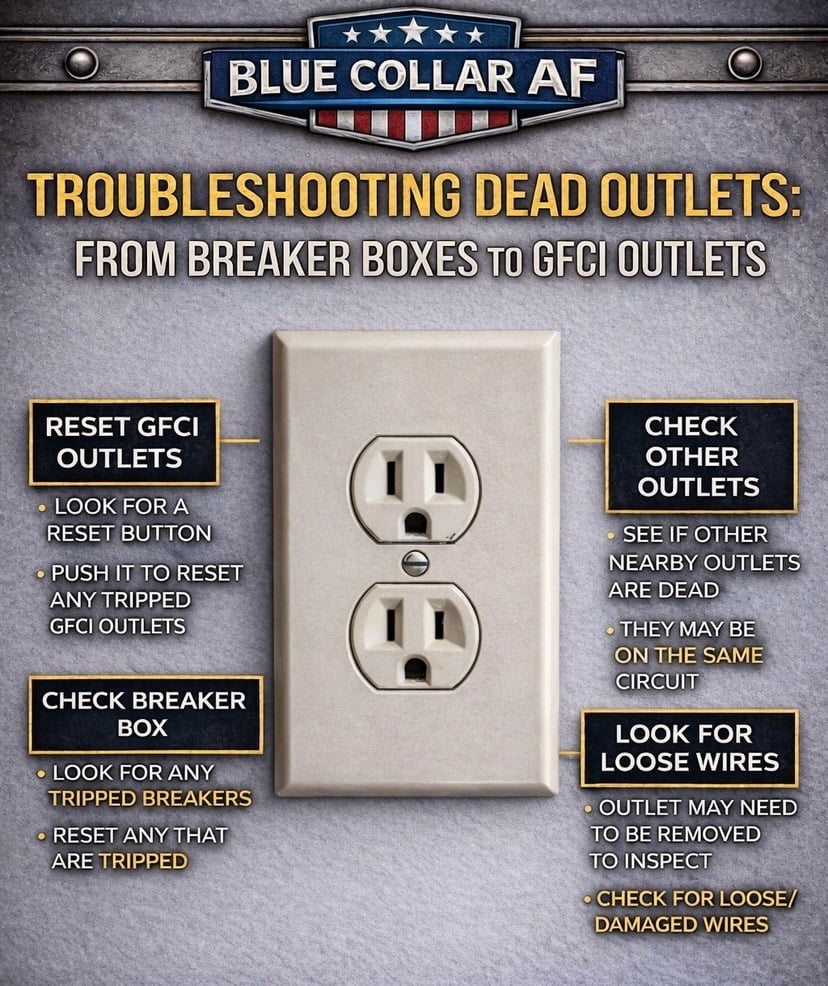
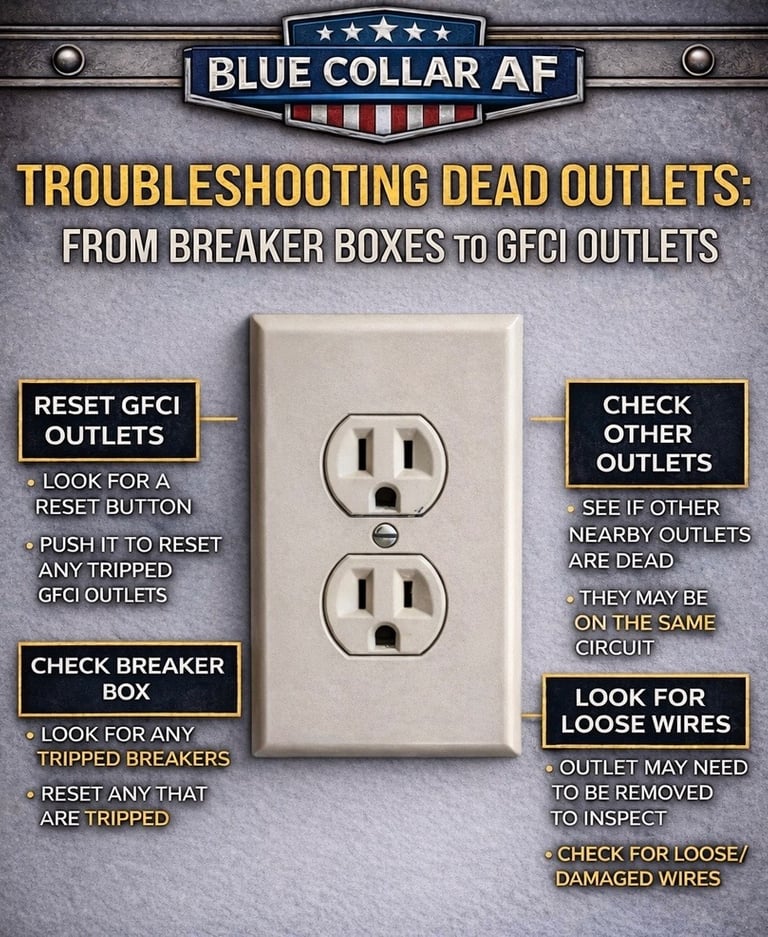
1. Check the Breaker Box
One of the first things to check is your electrical panel.
Sometimes a breaker trips and the dead outlet is simply on that circuit. The tricky part is that a tripped breaker does not always look fully flipped to the off position. It may sit somewhere between on and off.
What to do
• open the panel
• look for any breaker that appears out of position
• reset it by turning it fully off, then back on
If the breaker trips again right away, that usually points to a real problem on the circuit and not just a random nuisance trip.
2. Reset Any GFCI Outlets
This is one of the most common reasons an outlet seems dead.
A GFCI outlet can trip and shut off power not just to itself, but also to other outlets downstream on the same circuit. That means the dead outlet you are looking at may not be the actual problem outlet.
Where to look
Check nearby:
• bathrooms
• kitchens
• garages
• laundry rooms
• basements
• outdoor outlets
You may find a GFCI outlet with a popped reset button.
What to do
• press the reset button
• see if power returns to the dead outlet
A lot of people are surprised to find that a bathroom or garage GFCI is what shut off a completely different outlet nearby.
3. Check Other Outlets Nearby
If one outlet is dead, check the ones around it.
Sometimes several outlets are tied into the same branch circuit. If more than one is dead, that gives you a clue that the issue may be upstream, not just isolated to one receptacle.
This helps you figure out:
• whether it is one bad outlet or multiple
• whether a GFCI may be affecting the circuit
• whether the breaker issue involves more than one location
If several outlets in the same area are dead, the problem usually starts earlier in the circuit.
4. Look for Loose Wires or Bad Connections
Loose wiring is another common cause of dead outlets, especially in older homes or outlets that have seen years of use.
An outlet may look fine from the outside but still have:
• a loose hot wire
• a loose neutral
• a failed backstab connection
• a burnt terminal
• internal failure in the receptacle itself
Signs this may be the issue
• one outlet dead but breaker is fine
• intermittent power
• plugs fit loosely
• slight discoloration on outlet face
• outlet worked before and then suddenly stopped
If you remove the outlet to inspect it, always shut off the breaker first and verify power is off.
5. A Tripped GFCI Without an Obvious Problem
Sometimes a GFCI outlet keeps tripping because it is actually doing its job.
This can happen from:
• moisture
• a faulty appliance plugged into the circuit
• wiring issues
• a worn-out GFCI outlet
If the outlet resets and then trips again repeatedly, that is a sign you need to dig deeper.
6. The Outlet Itself May Be Bad
Sometimes the outlet is simply worn out or failed internally.
This is more likely if:
• the outlet feels loose when plugging things in
• power cuts in and out
• the outlet is old and heavily used
• there is heat damage or discoloration
Outlets are not expensive parts, but proper replacement still requires shutting off power and wiring it correctly.
7. Half-Hot or Switched Outlets
In some rooms, especially older living rooms or bedrooms, one half of an outlet may be controlled by a wall switch.
That can make it seem like the outlet is dead when really:
• the switch is off
• only one half is energized
• the switched side is being mistaken for a failed outlet
Always check nearby wall switches before assuming the receptacle has failed.
8. Outdoor and Garage Outlets Can Be More Problem-Prone
If the dead outlet is outside, in a garage, or in a damp location, moisture and GFCI trips are even more likely.
These outlets often see:
• temperature changes
• humidity
• water intrusion
• dirt and corrosion
So if the dead outlet is outside, definitely check all nearby GFCI devices first.
9. Burnt or Damaged Wiring Is a Bigger Warning Sign
If you find:
• blackened insulation
• melted plastic
• scorch marks
• a burning smell
• buzzing sounds
stop right there.
That is no longer a simple dead-outlet issue. That points to overheating, arcing, or a serious wiring problem that should be handled professionally.
Why an Outlet Tester Helps
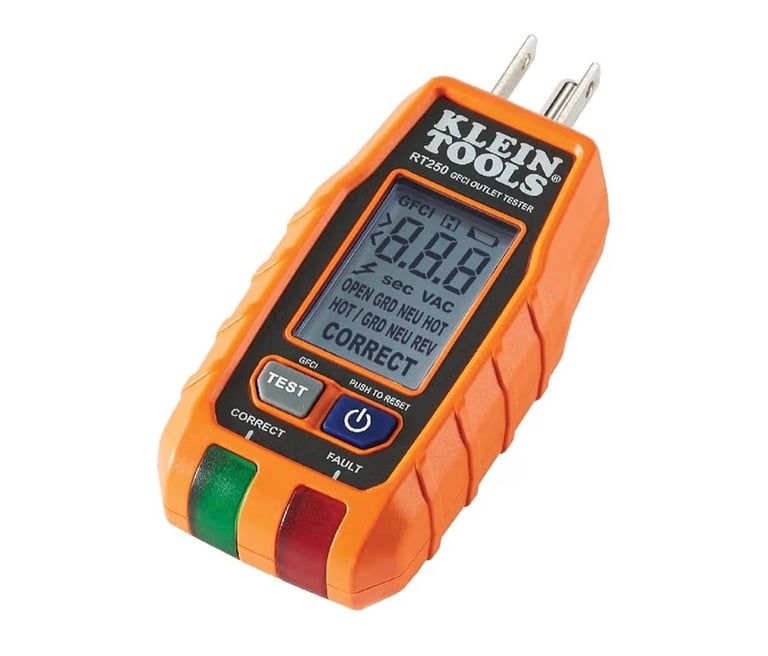
When troubleshooting dead outlets, one of the easiest tools to use is an outlet tester.
Instead of guessing, an outlet tester can quickly help you check for:
• proper wiring
• open ground
• open neutral
• hot/neutral reverse
• hot/ground reverse
• GFCI trip function on compatible outlets
That makes troubleshooting much faster and gives you a better idea of whether the outlet is actually wired correctly or if the problem is somewhere else on the circuit.
For homeowners, DIYers, and anyone doing basic outlet troubleshooting, this is one of those tools that can save a lot of time.
A Good Order to Troubleshoot Dead Outlets
Here is the simplest order to follow:
1. Check the breaker
Make sure nothing is tripped.
2. Check all nearby GFCI outlets
Reset any that have tripped.
3. Check nearby outlets
See whether it is just one or several.
4. Test the outlet
Use an outlet tester if you have one.
5. Inspect for loose or burnt wiring
Only if power is off and you are comfortable doing so.
6. Call an electrician if needed
Especially if the breaker keeps tripping or you find heat damage.
Final Thoughts
Dead outlets are usually caused by a handful of common issues: tripped breakers, tripped GFCIs, loose wires, bad receptacles, or problems elsewhere on the same circuit.
The key is to troubleshoot in a smart order instead of jumping straight to replacing parts.
A lot of the time, the fix is simpler than people think. And when it is not simple, the warning signs usually show you pretty quickly that it is time to stop and bring in a pro.
Recommended Tool
If you want an easy way to troubleshoot outlets faster, check out our recommended Klein Tools RT250 GFCI Outlet Tester on Amazon. It is a handy tool for checking outlet wiring, spotting common faults, and testing GFCI protection without a bunch of guesswork.
Help
Questions? Reach out anytime, we’re here.
Contact
© 2026. All rights reserved.