
Common Car Noises & What They Mean (Complete Diagnosis Guide)
In this article, we cover common sounds your car may make, and what could be causing them.
AUTOMOTIVE
3/31/20264 min read
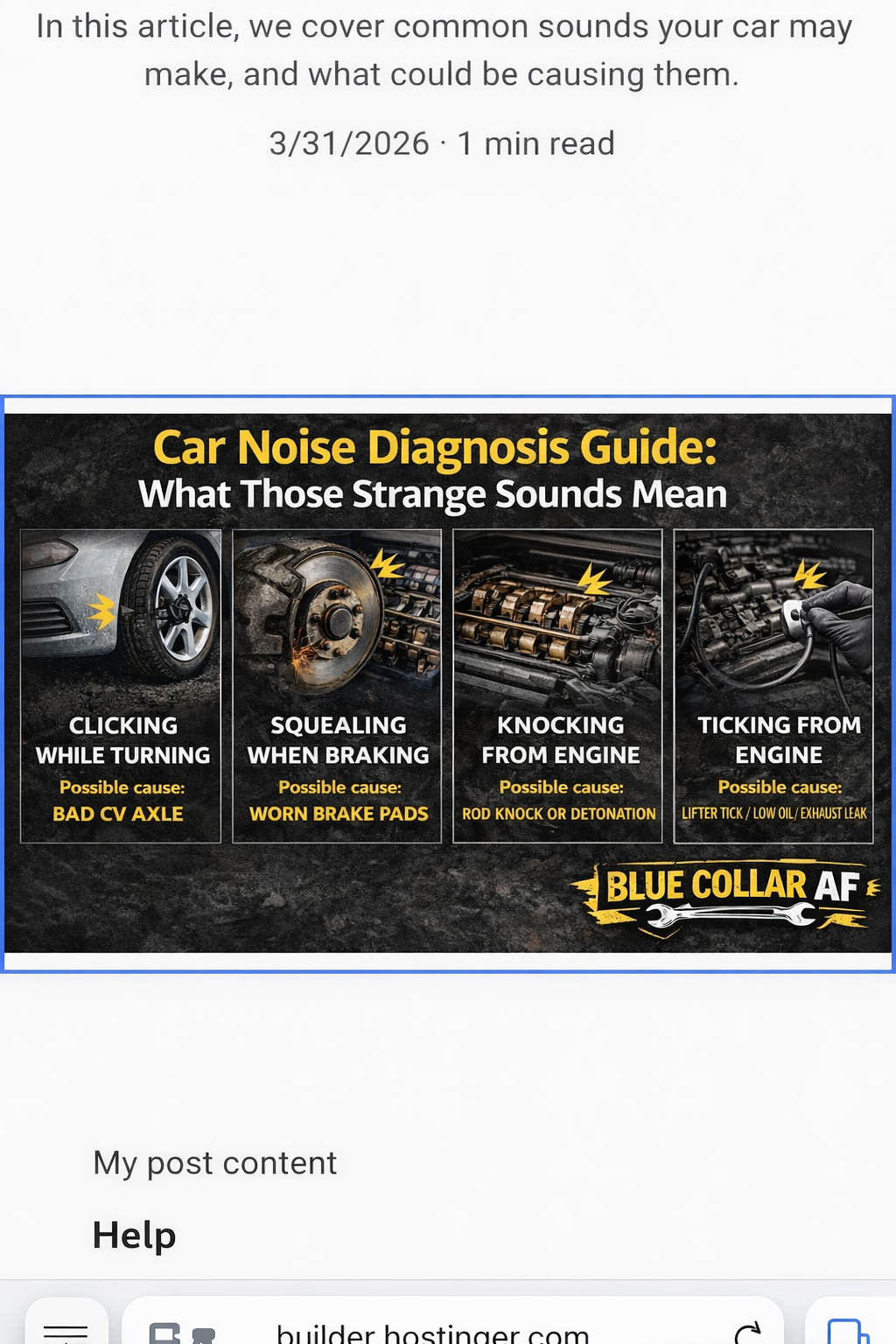
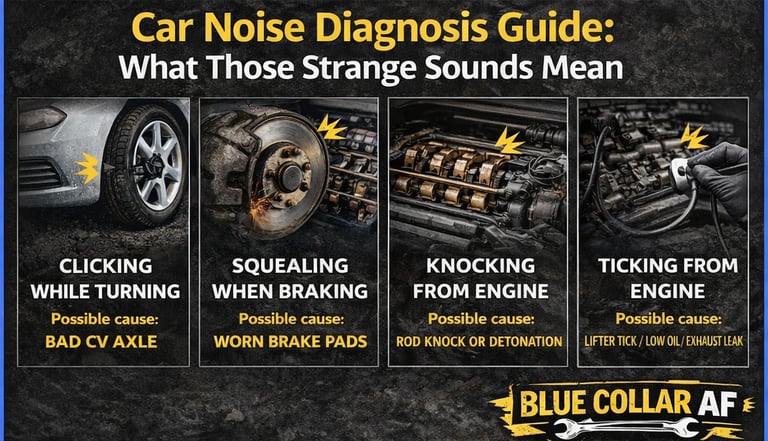
If your car suddenly starts making a strange noise, it’s usually your vehicle’s way of telling you something isn’t right. While some noises are harmless, others can signal serious mechanical problems that should be addressed quickly.
Professional mechanics often diagnose problems by listening carefully to the type of sound and when it occurs. Different noises—clicking, squealing, knocking, or ticking—can point to very different issues under the hood or in your drivetrain.
In this guide, we’ll break down some of the most common car noises, what causes them, and what you should do if you hear them.
Clicking While Turning
Possible Cause: Bad CV Axle
If you hear a rapid clicking or popping sound when turning your steering wheel, especially during tight turns or while accelerating, the most common cause is a worn constant velocity (CV) axle joint.
CV joints are responsible for transferring power from the transmission to the wheels while allowing them to move with the suspension and steering. Over time, the protective rubber boot around the joint can crack or tear. When that happens, grease escapes and dirt gets inside, causing the joint to wear out.
Signs of a failing CV axle
Clicking or popping sound when turning
Noise gets louder during acceleration
Grease visible around the wheel or suspension
Vibration while driving
Why this happens
CV joints operate under constant stress and rotation. Without proper lubrication, the internal bearings and components wear quickly, creating the clicking noise you hear.
Is it dangerous?
Driving with a worn CV joint can eventually lead to complete axle failure, which could leave your vehicle unable to move. If you notice consistent clicking when turning, it’s best to inspect the CV axle soon.
Squealing When Braking
Possible Cause: Worn Brake Pads
A high-pitched squealing noise when braking is one of the most common noises drivers encounter. In many cases, it’s simply the built-in wear indicator on your brake pads doing its job.
Brake pads are designed with a small metal tab that contacts the rotor when the pad material becomes too thin. That contact creates a squealing noise to warn you that it’s time for replacement.
Common causes of brake squealing
Worn brake pads
Brake dust buildup
Glazed brake pads
Moisture on rotors
When it becomes serious
If the noise changes from squealing to grinding, that usually means the brake pads are completely worn and metal components are contacting the rotor.
Grinding brakes can damage rotors and dramatically increase repair costs.
Signs your brakes need attention
Squealing or grinding when braking
Reduced braking performance
Steering wheel vibration while braking
Longer stopping distances
Brake issues should always be addressed quickly since they directly affect vehicle safety.
Knocking From Engine
Possible Cause: Rod Knock or Detonation
One of the more concerning sounds a vehicle can make is a deep knocking or banging noise coming from the engine.
Two common causes are rod knock and engine detonation.
Rod Knock
Rod knock occurs when the bearings connecting the piston rods to the crankshaft wear out. This creates excessive clearance, causing the rod to move slightly and produce a knocking sound as the engine rotates.
Symptoms include:
Loud knocking that increases with RPM
Low oil pressure
Metallic banging sound from engine block
Rod knock often indicates serious engine wear and may require significant repairs.
Engine Detonation (Spark Knock)
Detonation happens when the air-fuel mixture ignites improperly inside the combustion chamber. Instead of a smooth burn, the fuel explodes unevenly, creating a knocking sound.
Common causes include:
Low octane fuel
Carbon buildup in cylinders
Faulty knock sensors
Incorrect ignition timing
If you hear knocking under acceleration, it’s important to diagnose the issue quickly to avoid engine damage.
Ticking From Engine
Possible Causes: Lifter Tick, Low Oil, or Exhaust Leak
A ticking noise coming from the engine bay is fairly common and can have several possible causes.
The sound usually resembles a fast, repetitive tapping that changes with engine speed.
Lifter Tick
Many engines use hydraulic lifters that rely on oil pressure to maintain proper valve operation. If oil pressure drops or lifters become worn, they may produce a ticking noise.
This is especially common during cold starts when oil hasn’t fully circulated yet.
Low Engine Oil
Insufficient oil can prevent proper lubrication of engine components, causing ticking or tapping noises.
Always check oil levels if you hear new engine noises.
Exhaust Manifold Leak
Small cracks or gasket leaks in the exhaust manifold can also create a ticking sound. This happens because exhaust gases escape rapidly with each combustion cycle.
Symptoms of an exhaust leak include:
Ticking noise near engine
Strong exhaust smell
Reduced engine performance
How Mechanics Diagnose Engine Noises
Diagnosing engine noises can be challenging because sound travels through metal components and may appear to come from different areas.
Professional technicians often use specialized tools to pinpoint the exact source.
Common diagnostic steps include:
Listening closely to engine components
Checking oil levels and condition
Scanning for engine codes
Inspecting moving components
Using diagnostic listening tools
This process helps identify whether the issue is coming from the engine, drivetrain, brakes, or suspension.
A Tool That Makes Diagnosing Car Noises Much Easier
One of the most useful tools for tracking down strange engine noises is a mechanic’s stethoscope.
This simple but effective tool allows you to listen directly to different parts of the engine while it’s running.
By placing the probe on components like the valve cover, fuel injectors, alternator, or water pump, you can isolate the exact source of the sound.
Mechanics commonly use stethoscopes to diagnose:
Lifter tick
Bearing noise
Injector operation
Pulley and accessory noise
Internal engine sounds
If you enjoy working on your own vehicles, a mechanic stethoscope can be an incredibly helpful addition to your toolbox.
checkout our favorite Stethoscope on Amazon